Home > News > Blog > What is the main advantage of a Teflon needle?
share
What is the main advantage of a Teflon needle?
Jul 08Source:Intelligent Browse: 110
The biggest benefit of a teflon needle is its smooth and non-stick surface. This special part helps glue move easily and stops it from getting stuck. Contriu sells a teflon needle that is good for factories that use fast-drying glue. Workers can trust this needle for neat, exact, and fast glue use.
Key Takeaways
Teflon needles have a smooth surface. They do not let things stick. Glue and liquids move easily through them. This helps stop clogs and saves time.
These needles are strong and do not rust. They work well with strong chemicals. Many industries use them for this reason.
Using Teflon needles means you clean less often. Workers can do their jobs more and spend less time cleaning.
Teflon-coated needles are easy to push in. They need less force. This makes them more comfortable to use. It also helps people not get tired as fast.
Picking the right size Teflon needle is important. Think about how thick the liquid is. Also, think about what you will use it for. This helps it work best.
Teflon Needle Overview
Material and Design
Contriu makes its teflon catheter needle to work well and last long. The needle has a strong stainless steel core. This helps it stay tough and accurate every time it is used. Around the steel, the teflon catheter forms a smooth path for glue or other liquids. This mix gives a slippery, non-stick surface. It stops glue from getting hard inside the catheter.
Many features make the teflon catheter great for factories:
It resists many chemicals, so it does not break down when used with glue or cleaners.
Its smooth inside lets glue move easily, so there are fewer clogs and work goes faster.
It can handle very hot or cold places, so it works the same in tough spots.
The non-stick inside keeps fast-drying glue from sticking, so cleaning is easy.
Contriu sells teflon catheter needles in sizes from 20G to 27G. They come in colors like grey, pink, and red. In busy factories, the needle’s design helps workers put glue on quickly and neatly. Each box has 1,000 needles, so it saves money for big jobs.
Industrial Applications
Factories use the teflon catheter needle when they need glue to flow without problems. Many businesses like that the catheter stands up to strong chemicals and lasts a long time. Here is a table that shows how different industries use teflon catheter needles:
Industrial Sector
Primary Reasons for Adoption
Chemical Processing
Handles strong chemicals, does not rust
Aerospace
Works in high heat, stays strong in tough places
Automotive
Lets things move smoothly, lasts in fuel and fluid systems
Electronics
Keeps signals clear, works well in devices
Medical/Food Processing
Safe for food, does not let stuff build up inside
Teflon catheter needles keep getting better as new ideas come out. They now last longer, fight off more chemicals, and work in hotter or colder places. This helps factories that need parts that work well and are safe. Machines that use teflon catheter needles can run longer without stopping. Workers get steady results, so they can do more work.
Main Advantage of Teflon-Coated Needles
Reduced Friction
Teflon-coated needles are special because they make things smoother. The teflon layer gives a slick path for glue or other liquids. This helps glue move through the needle without getting stuck. Many factories pick teflon-coated needles for this reason. Workers see that glue moves faster and spreads out better.
A lab test checked how teflon-coated needles change friction. Scientists saw that teflon can bend a little, which stops leaks and helps things move smoothly. This means teflon-coated needles keep glue or other liquids moving without stopping or clogging.
Tip: When there is less friction, you do not need to push as hard. This makes the job easier and helps machines last longer.
Teflon-coated needles are also good for thick or sticky stuff. The teflon inside keeps the needle slippery. This lowers the chance of glue drying up or blocking the way. Factories using teflon needles have fewer slowdowns and waste less glue.
Non-Stick Performance
Another big plus of teflon-coated needles is their non-stick power. The PTFE liner inside stops glue from sticking to the metal. This keeps the needle clean and ready to use again. Workers do not need to stop often to clean or swap out the needle.
When you use teflon-coated needles, glue does not pile up inside. The PTFE lining keeps glue away from the metal. This stops glue from hardening and blocking the needle. So, the flow stays smooth, and the needle works longer without trouble.
A study found that PTFE-lined tips work well with sticky or fast-drying glue. The non-stick layer keeps the end of the needle clear. This means less cleaning and fewer stops during long work times. Workers can focus on their jobs instead of fixing clogged needles.
Benefit
How Teflon-Coated Needles Help
Less residue buildup
Glue does not stick or cure inside the needle
Fewer cleaning cycles
Workers spend less time on maintenance
Longer production runs
Needles stay open and ready for use
Teflon-coated needles are a great choice for anyone who needs glue to go on smoothly and easily. Contriu’s teflon needle uses these good points to help factories work faster and with fewer problems. Because they lower friction and do not let glue stick, teflon-coated needles are picked by many businesses.
Steel Versus Teflon
Durability Comparison
Factories look at steel and teflon when picking needles for glue or liquid jobs. They want tools that last long and do not break easily. Stainless steel needles are strong. They can handle a lot of pressure and keep their shape for a long time. But steel can rust if it gets wet or touches strong chemicals. When this happens, the needle might need to be replaced.
Teflon-coated needles have a special layer. This layer keeps the steel inside safe from rust. It also helps the needle last longer. Many factories like that teflon works well with strong chemicals. The table below shows how different coatings change how long needles last:
Coating Type
Corrosion Resistance
Wear Resistance
Durability Improvement
Dursan Coating
Superior
Improved
Enhanced
Uncoated Stainless
Standard
Standard
Standard
Teflon-coated needles are best in places where things can rust fast. They work with many liquids and stay in good shape longer. This means workers do not have to stop as much to change needles. Teflon works with lots of fluids, so many factories use it.
Insertion Experience
How a needle goes in is important for workers and clients. There are big differences between steel and teflon here. Stainless steel needles can make more friction when used. This can make them harder and less comfy to use. Teflon-coated needles slide in easier. The teflon makes them smooth, so they do not stick.
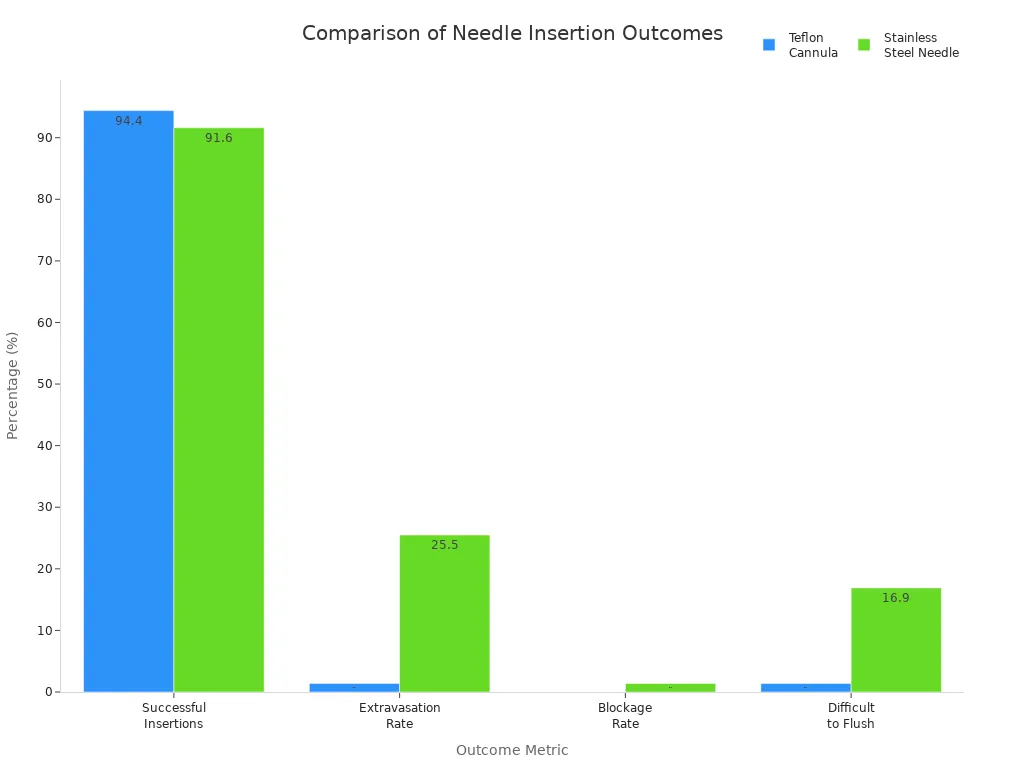
Tests show teflon-coated needles need less force to go in. Workers say their hands do not get as tired. Clients think the process feels smoother. The chart below shows how teflon cannulas and steel needles compare:
The table below shows the results:
Needle Type
Successful Insertions
Extravasation Rate
Blockage Rate
Difficult to Flush Rate
Teflon Cannula
67 of 71 (94.4%)
1 of 71 (1.4%)
0 of 71 (0%)
1 of 71 (1.4%)
Stainless Steel Needle
65 of 71 (91.6%)
18 of 71 (25.5%)
1 of 71 (1.4%)
12 of 71 (16.9%)
Teflon-coated needles need less force to use.
The smooth surface makes them more comfortable.
Workers’ hands do not get as tired.
Teflon works well with many liquids.
Teflon needles also work better with different liquids. They do not rust or get blocked as much. Steel needles may need more cleaning and can rust in tough places. The steel inside a teflon needle stays safe. This means the needle works better and lasts longer.
Pros and Cons
Teflon Needle Benefits
Teflon needles have many good points for factories and hospitals. The PTFE coating makes the surface smooth and slippery. This helps glue and liquids move without sticking. Workers see fewer blockages and less time wasted. The stainless steel inside keeps the needle strong and stops it from bending. Factories use these needles with lots of chemicals because PTFE does not rust.
Key benefits include:
Smooth, non-stick surface for easy flow
Fewer clogs and less cleaning needed
Strong stainless steel core for durability
Works well with many chemicals
Handles high and low temperatures
Note: Many factories pick Teflon needles for fast-drying glue. They help keep production lines running.
Teflon Needle Drawbacks
Teflon needles have some downsides too. Sometimes, thick or sticky stuff can block the needle. Workers may need to clean or change the tip more often. Big syringes hold less glue than large machines, so workers must refill them more. Some factories find that setting up automatic glue systems costs more at first. New workers may need lessons to stop bubbles and get smooth glue.
Clogging can happen with viscous materials, requiring frequent cleaning
Limited volume in syringes means more refills
Automation systems can be expensive for small workshops
Operators need training for best results
There are also worries about the environment. PTFE coatings use only a little material, but makers and rule-makers try to cut down pollution from PFAS. Many companies now search for safer and greener coatings.
Stainless Steel Needle Pros and Cons
Stainless steel needles are still used in many places. They are very strong and do not bend easily. These needles are good for simple jobs and cost less than coated ones. But they can rust if they touch harsh chemicals or water. Without a non-stick surface, glue or other stuff may stick inside. This means more cleaning and more blockages.
Feature
Stainless Steel Needle
Teflon Needle
Strength
High
High
Corrosion Resistance
Moderate
Excellent
Non-Stick Surface
No
Yes
Maintenance Needed
More
Less
Environmental Impact
Lower (no PTFE)
PTFE concerns
Tip: Users should think about the good and bad points of each needle. They should pick what fits their work and needs best.
Choosing Teflon Needles
When to Use
Factories and clinics pick a Teflon needle set when they want glue to move smoothly or need gentle needle use. The set works best for people who use insulin pumps all the time. It helps stop the tube from bending and lowers the chance of problems. Many people with type 1 diabetes trust this set to get their insulin safely. The set also helps with checking blood sugar all the time.
Doctors use the set for patients who need less pain or skin damage. The set slides into the skin easily, so it hurts less. It is good for people who are allergic to metal. The set makes a shield to stop skin problems. Factories use the set to put glue on things. The set does not get ruined by weak acids or bases like acetic acid. It can help machines last longer by stopping clogs and making cleaning easier.
Tip: This set is a smart pick for anyone who wants to stop high blood sugar from pump problems or bent tubes. The set keeps insulin moving and helps keep blood sugar steady.
User Considerations
People should think about a few things before picking a Teflon needle set. The set needs to work with the thickness of the liquid, like insulin or glue. It should let the right amount of liquid move for insulin pumps. The set must work with the other parts used. It should also help with checking blood sugar all the time.
Cleaning the set is important. People should use cleaners that do not have strong bases, phosphates, or soap. After cleaning, rinse the set with special water and acetone. Use a tissue that does not leave fuzz to wipe off anything left. Make sure no cleaner is left before using or putting away the set.
Regulatory Body
Standard/Recommendation
Year
Description
EPA
Elimination of PFOA
2010
Recommended the elimination of PFOA in all PTFE coatings by 2015, including medical devices.
EU
Upcoming restrictions
N/A
Considering elimination of PFAS chemicals, impacting medical device manufacturing.
People should follow these rules to stay safe and follow the law. The set helps with insulin pumps, checking blood sugar, and stops problems with the tube. The set also helps control high blood sugar and works with insulin pumps. The set is important for people with diabetes who want to keep their blood sugar right and avoid problems from bent or blocked tubes. The set makes the pump work better and helps medical tools last longer.
Teflon needles have a smooth and non-stick surface. This helps glue and liquids move without getting stuck. Many factories and clinics pick Teflon needles because they do not rust. They also work well in hot places. More people are buying Teflon lined needles every year. Experts think the market will be worth 2 billion dollars by 2030. Healthcare workers like these needles because they are safe and accurate.
Teflon needles are used to make vaccines and for medical tests.
They help stop germs and keep machines working longer.
Contriu sells Teflon needles with strong stainless steel inside. People should look at both Teflon and stainless steel needles. Teflon is better for sticky or fast-drying stuff. Stainless steel is good for simple jobs. Pick the needle that works best for your job and helps you work well.
FAQ
What makes a Teflon needle different from a regular needle?
A Teflon needle has a PTFE coating. This coating makes the surface smooth and slippery. Glue or liquids can move through it easily. The needle does not get clogged as much. Regular needles do not have this coating. They can get blocked more often.
Can Teflon needles handle strong chemicals?
Yes, Teflon needles can handle strong chemicals. The PTFE layer keeps the steel inside safe. This helps the needle work well in tough places.
Why do factories prefer Teflon needles for glue?
Factories like Teflon needles because glue does not stick inside. Workers do not need to clean or change them as much. This helps the factory keep working without stopping.
Are Teflon needles safe for medical use?
Teflon needles are safe for many medical jobs. The smooth surface helps the needle go in gently. It also helps stop skin damage. Many doctors use them for insulin pumps and blood tests.
How do I choose the right size Teflon needle?
Tip: Pick the needle size by looking at how thick the liquid is and what you need it for. Contriu has sizes from 20G to 27G. You can pick the size that fits your job.