In precision fluidics, automated chemical dispensing, and clinical laboratory automation, the mechanical integrity of fluidic junctions represents a critical variable. When managing high-viscosity reagents, volatile solvents, or biological micro-samples, the slightest micro-leakage or compliance-induced volume variance can invalidate analytical results or cause expensive cross-contamination.
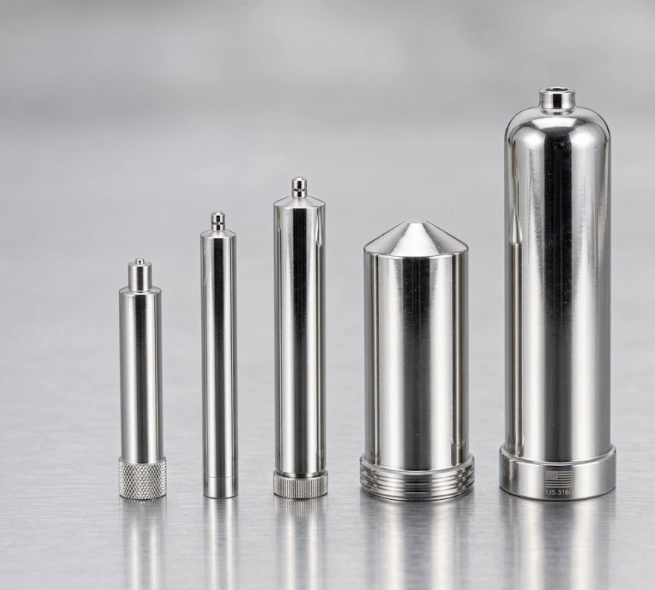
To overcome the performance limits of traditional polymeric connectors—which frequently crack under mechanical stress or degrade when exposed to aggressive organic solvents—system designers are upgrading to a high-precision metal detachable fitting. These specialized components provide an unyielding structural bridge between dispensing syringes, delivery lines, and clinical needles, ensuring absolute volumetric accuracy under varying hydrostatic pressures.
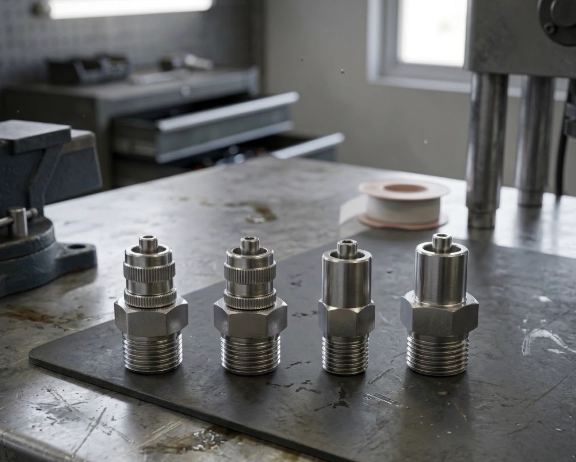
The Metallurgy and Structural Geometry of Micro-Fluidic Coupling
The operational value of an industrial-grade metal detachable fitting lies in its thread geometry and surface finish. Unlike plastic luers that suffer from material creep and thread deformation when over-torqued, metallic components maintain cross-sectional geometry even after hundreds of autoclave sterilization cycles.
Typically machined from 316L medical-grade stainless steel or biocompatible titanium alloys, these fittings feature chemically passivated fluid paths. This prevents metal ion leaching into sensitive biological samples.
Furthermore, the internal fluidic pathway is polished to a mirror finish (often achieving Ra≤0.4 µm). This smooth surface profile eliminates turbulent micro-eddies, minimizes sample carryover, and prevents localized shear stress. Such stress can prematurely shear delicate macromolecular structures or break down long-chain polymers during high-velocity dispensing cycles.
Universal Needle Integration: Seamless 1/4 and 1/8 Turn Adaptations
A primary challenge in high-throughput laboratories is managing the wide variety of needle hubs used across different suppliers. A high-performance metal detachable fitting for syringe connection resolves this issue by integrating a universally compatible interface layout.
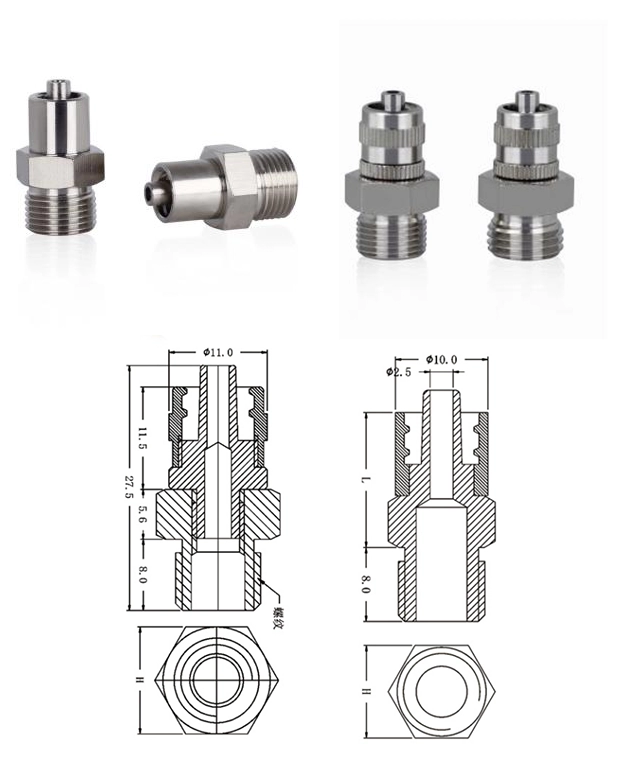
The precision engineering of the external thread path is specifically configured so that the external thread is connected to any needle, such as 1/4 turn standard syringe and 1/8 turn standard syringe, which is convenient for connecting syringe and needle.
Advanced Interfacing Configurations
● 1/4 Turn Standard Syringe Mechanisms: Engineered for higher-torque fluidic paths, the 1/4 turn locking profile provides rapid mechanical engagement. It creates a robust seal capable of handling pressure spikes without backing out or loosening during high-frequency stop-start cycles.
● 1/8 Turn Standard Syringe Profiles: Designed for space-constrained multi-channel manifold arrays. The short rotational arc allows technicians or robotic pick-and-place grippers to attach or detach needles in tight spaces, significantly simplifying field maintenance.
● Universal Needle Adaptability: By standardizing the external mating face, this design allows custom micro-cannulas, standard blunt-tip lab needles, and specialized atomizing nozzles to lock directly onto the fitting with perfect axial alignment.
This seamless versatility eliminates the need for expensive, single-source proprietary needles. It gives laboratory procurement managers the flexibility to source consumables without sacrificing fluid path integrity.
Uncompromising Reliability: The Contriu Fluidic Advantage
When scaling up to automated, multi-station industrial filling systems or clinical diagnostic instruments, any variance in part-to-part manufacturing leads to costly calibration downtime. This is where the machining precision of Contriu sets a new standard for fluidic reliability.
Every Contriu metal detachable fitting is engineered with a strict low-dead-volume interior. This design removes internal fluid pockets where air bubbles could become trapped, preventing compliance issues and ensuring precise volumetric dispensing down to microliter scales.
The physical external hex or knurled pattern developed by Contriu provides excellent tactile grip for manual assembly, while also matching standard automated torque-wrench profiles used in robotic assembly lines.
Additionally, Contriu maintains strict axial alignment tolerances between the internal receiving luer and the external thread profile. This high concentricity prevents needle tip deviation during automated XY-axis positioning, protecting fragile needles from impact damage and misaligned injections.
Eliminating Fluidic Compliance and Outgassing in High-Vacuum Systems
In addition to positive-pressure liquid handling, a high-quality metal detachable needle adapter is vital for high-vacuum aspiration and outgassing analysis systems.
Plastic fittings often suffer from microscopic outgassing under deep vacuum conditions or expand under high pressures—a phenomenon known as fluidic compliance. This elasticity buffers the pressure wave, leading to fluid "drooling" or delayed shut-off at the needle tip.
High-Vacuum and Pressure Performance Factors:
1. Rigid Fluid Isolation: The unyielding nature of a Contriu metallic connection prevents any physical expansion, ensuring that the pressure pulse from the syringe plunger transfers directly to the needle tip for clean fluid cut-off.
2. High Thermal Thresholds: Capable of operating in environments from -50°C up to +300°C, these fittings handle high-temperature gas chromatography and chemical synthesis lines that would melt or deform standard plastic components.
3. Hermetic Sealing Compatibility: When paired with specialized elastomeric or soft-metal washers, these detachable fittings achieve hermetic seals, ensuring leak-free performance even when running volatile organic compounds (VOCs) or liquefied gases.
Conclusion
Although often overlooked, the Metal Detachable Fitting is one of the most important components in any precision dispensing system. Its ability to provide secure syringe-to-needle connections, maintain stable fluid flow, and simplify equipment maintenance directly influences production efficiency and dispensing accuracy.
With an external threaded design compatible with 1/4-turn standard syringes, 1/8-turn standard syringes, and a wide variety of dispensing needles, Contriu Metal Detachable Fittings offer an ideal solution for manufacturers seeking reliability, flexibility, and long-term performance.
Whether used in electronics manufacturing, medical devices, automotive production, laboratory research, or industrial automation, investing in high-quality metal detachable fittings helps reduce downtime, improve dispensing consistency, and support higher-quality manufacturing outcomes.