Home > News > Blog > Who manufactures stainless steel dispensing needles for industrial use?
share
Who manufactures stainless steel dispensing needles for industrial use?
Jul 29Source:Intelligent Browse: 114
Contriu makes strong needles with 304 stainless steel. Their needles have blunt tips and you can choose the length. Good suppliers have products that last a long time. They help you use fluids accurately. They also make new designs and care about the environment. Pick brands that make customers happy. These brands give good performance and helpful support.
Key Takeaways
Pick stainless steel dispensing needles from trusted makers like Contriu. These brands give good quality and reliability.
Choose the right needle gauge for the fluid’s thickness. This helps the fluid flow well and stops clogs.
Think about the tip style and length that fits your job. This gives better accuracy and control when you use the needle.
Find makers with certifications like ISO 9001. This shows the needles are safe and made with high standards.
Using the right dispensing needle can make your work more precise. It can also cut down waste and help your workflow go smoother.
Leading Stainless Steel Dispensing Needle Manufacturers
Contriu and Its Stainless Steel Needle
If you need a good adhesive dispensing needle, Contriu is a great pick. Contriu makes stainless steel dispensing needles that meet high standards. You can pick from many gauges, like 14G to 32G. Each needle is made with 304 stainless steel. This makes them strong and stops rust. The blunt tip helps you control glue or fluid flow. Contriu’s adhesive dispensing needle has a brass nickel-plated holder. This holder keeps the needle steady and secure.
You can choose different lengths, like 1/4 inch, 1/2 inch, 1 inch, or 1.5 inches. Contriu can also make special sizes if you need them. The inside of each stainless steel dispensing needle is smooth. This stops glue from sticking inside. It helps you use glue cleanly and accurately. The snap-on design uses CNC machining. This keeps the needle in place and makes it simple to use.
Contriu gives you different tip styles. You can get a 1-inch blunt end or a 45° angle tip. These tips have a double-threaded design. This keeps them tight even when used a lot. They work well with low-viscosity adhesives. This makes them good for careful adhesive dispensing in many jobs.
Here is a table that shows the gauge range and details for Contriu’s stainless steel dispensing needle:
GAGE
Color
DT part number
Inside mm
pcs/box
14
Olive
DT041001
1.55
50
15
Amber
DT041002
1.37
50
18
Green
DT041003
0.84
50
20
Pink
DT041004
0.58
50
21
Purple
DT041005
0.51
50
22
Blue
DT041006
0.41
50
23
Orange
DT041007
0.33
50
25
Red
DT041008
0.25
50
27
Clear
DT041009
0.20
50
30
Lavender
DT041010
0.15
50
32
Yellow
DT041011
0.10
50
34
Violet Blue
DT041042
0.06
50
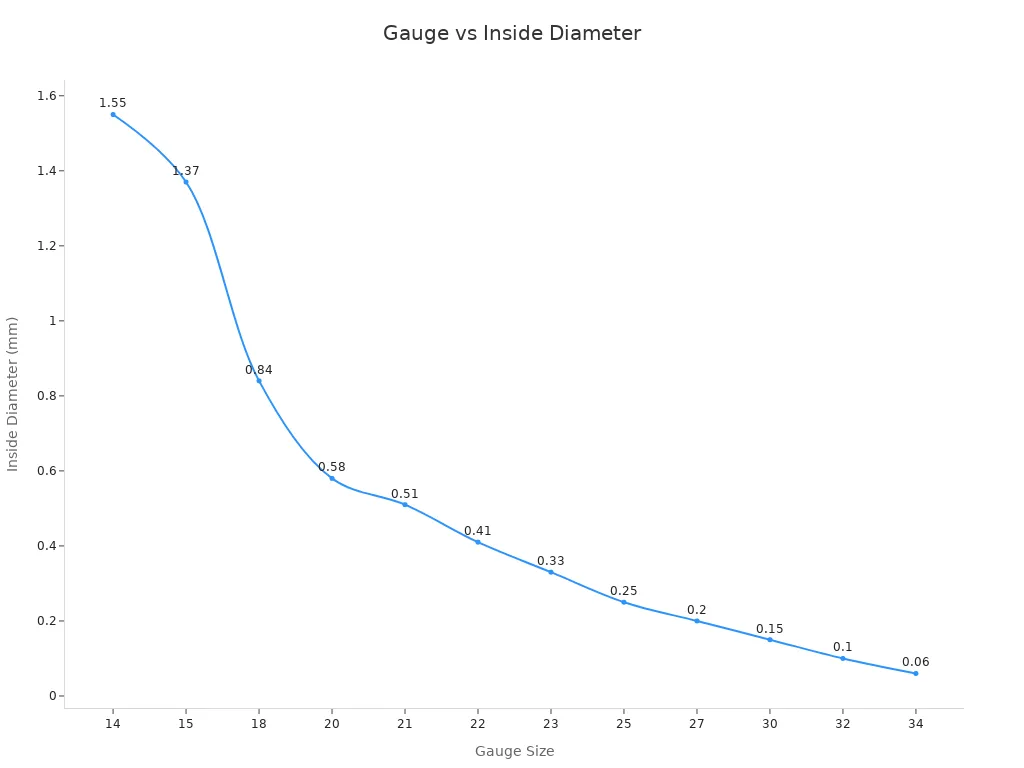
You can see how the inside diameter changes with each gauge in the chart below:
If you want a special length for your adhesive dispensing needle, Contriu can help. You need to order at least 1,000 pieces for a custom size. This lets you get the stainless steel dispensing needle that fits your needs.
Manufacturer Distinctions and Certifications
Product Quality and Material Standards
It is important to pick a dispensing needle that meets high standards. Most manufacturers use 304 stainless steel for these needles. This material is strong and does not react with chemicals. The table below shows what classic dispensing needles are like:
Feature
Description
Needle Type
Classic dispensing needle
Point Type
Blunt (probe) point
Cannula Material
304 Stainless Steel
Hub Material
Polypropylene Luer lock hub
Properties
Anti-static, Non-Sterile
Manufacturers test the needle material to make sure it does not rust. This helps the needle last a long time and work well. Some brands use 316L stainless steel for even better protection. This type is good for strong adhesives and tough chemicals. The table below compares the two main needle materials:
Attribute
304 stainless
316L stainless
Composition
~18% Cr, 8% Ni
adds 2–3% molybdenum, max 0.03% carbon
Chloride / acid resistance
Standard
~2–3× better pitting & crevice resistance
Weld / heat sensitization
Standard
Low-carbon resists carbide formation
Choose it for
General adhesive, epoxy, UV-cure, most 2-part
Acidic or aggressive adhesives, anaerobics, solvents, chlorides, long contact
Manufacturers check each dispensing needle for size and shape. They look at the needles and test how air moves through them. They also check the packaging. These steps help stop clogs and problems. You get smooth and steady results every time.
Industry Certifications and Compliance
You need to know your dispensing needle is safe and follows the rules. Manufacturers get certifications like ISO 9001 and ISO 13485. These show the company uses good quality controls for medical and industrial products. The table below lists common certifications:
Certification
Relevance to Industry
ISO 9001/13485
Compliance with quality management standards for medical devices
Manufacturers give you papers to prove their products are safe. You can find RoHS and REACH papers, FDA support, and safety data sheets. You also get reports on how safe and accurate the needles are. Lot numbers and batch records help you track every needle. These steps keep you safe and make sure the needles work well.
Tip: ISO standards help companies make safer and better products. You get better results and safer needles.
Customer Support and Reliability
You want good help when you buy dispensing needles. Top manufacturers give you many ways to get support. You can call or use their website for help. They follow strict rules for making and checking their products. You can ask for special labels, packages, or formulas. You can get these needles almost anywhere in the world.
Service Type
Description
Contact Options
Website and phone support for inquiries
Quality Management
Strict standards in manufacturing and service delivery
Customization Services
Custom formulation, labeling, and packaging
Global Supply
Worldwide product availability
Manufacturers use strong quality checks. You get your order on time and can get help after buying. Experts can help you pick the right needle for your job. Fast samples help you keep working without delays. You can get needles made just for your needs. You can trust your dispensing needle to work well and resist chemicals every time.
How to Choose the Right Dispensing Needle
Choose a Needle Gauge for Your Application
You need to pick a needle gauge that fits your job. Knowing about gauge sizes helps you choose the right needle. The gauge changes the inside size, which controls how glue or fluid moves. Bigger gauge numbers mean thinner needles. This changes the outside and inside sizes and the wall thickness.
When you pick a gauge, think about these things:
How thick the fluid is
How fast you want it to flow
What material you are using
If your fluid is thin, use a small diameter needle. This gives you better control and more precise flow. If your fluid is thick, use a bigger diameter needle. This lets it flow faster and stops clogs. Picking the right gauge helps you get steady glue output and waste less material.
Your job needs also matter. Small jobs or micro-bonding need small needles for careful drops. Filling gaps or bonding big parts works best with bigger openings that give more fluid quickly. You must match the gauge to your job to get the best results.
Tip: Always check how thick your fluid is and how fast you need it to flow before picking a needle gauge. This helps you get the right needle for your work.
Selecting Tip Style and Length
Tip shapes are important for accurate dispensing. You can pick blunt tips, angled tips, or bent tips. Each style works for different jobs. For electronics, a 90° bent stainless steel tip with a 30 gauge and 0.5-inch length is good for careful drops.
Property
Value
Gauge Size
30 Gauge
Tip Style
90° Bent Stainless Steel
Needle Length
0.5 inch (12.7 mm)
Needle length helps you reach different spots. Long needles help you get to hard places. Short needles give you better control in tight spaces. The gauge also affects flow and accuracy. Small gauge needles are best for slow flow and careful work. Big gauge needles let fluid move faster.
Pick tip shapes based on your job needs. Contriu has blunt and angled tips. You can pick the length that fits your job. You can get custom lengths if you need special sizes.
Note: The right tip shape and length help you be more accurate and make your work easier.
Matching Needle to Fluid and Task
You must match the needle to the fluid and job. This helps you avoid clogs and problems. The fluid’s chemistry, needle material, hole size, and tip shape all matter.
Compatibility Factor
Explanation
Chemistry of the Fluid
Pick the needle based on the fluid’s chemistry to stop clogs and problems.
Needle Material
Choose the right material to stop downtime and issues.
Bore Size
Match thickness and particle size to get good flow and stop blockages.
Tip Shape
Pick a tip shape that works with the fluid’s resistance for best performance.
Match the hole size to the fluid’s thickness and particle size. For filled epoxy, thermal paste, and silicone, use 14-18G with a tapered tip. Solder paste needs a needle hole at least five times bigger than the biggest powder particle, usually 18-22G. Coarse Type 3 paste works best with a 300µm hole. Thin glue, ink, or flux can be used with 22-27G.
The inside of a blunt needle is smooth. This stops fluid from speeding up at the tip. When the inside gets smaller and the fluid gets thicker, you need more pressure to keep it moving. Fluids with particles can block a small hole. You must pick the right hole size and tip shape for the fluid’s thickness and particle size.
Manufacturers give advice for matching fluids. For thin fluids, use a small general tip for better control. For solvents, a PTFE-coated tip stops fluid from sticking and helps accuracy. Thin glue needs PTFE-lined tips because it dries fast. For thick fluids, SmoothFlow tapered tips help flow and let you use less pressure.
Tip: Always check the fluid’s properties and your job needs before picking a needle. This helps you get the best flow and results.
You can pick the right needle by thinking about gauge, tip shape, length, and fluid match. Contriu’s product details help you choose the best needle for your job. You get smooth flow, accurate drops, and good results every time.
You should pick a trusted company for stainless steel dispensing needles. Good needles help fluids move smoothly and give accurate results. Certified products keep you safe and lower problems.
More than 60% of problems come from bad equipment, so quality is important.
Certified needles can lower injury risk by 30%. When you choose the right needle, you get more than just good results:
Benefit
Description
Improve Precision
The right gauge lets you use the exact amount.
Enhance Safety
Safe tips help stop injuries.
Reduce Waste
Smart design saves materials.
Prevent Workflow Disruption
Reliable needles keep your work going.
Contriu makes strong, accurate, and dependable needles. Choose carefully to get the best results for your job.
FAQ
What makes a stainless steel dispensing needle suitable for adhesive applications?
The needle should not rust or break down. Stainless steel is strong and works with most adhesives. It helps glue flow smoothly and stops clogs. Always make sure your adhesive works with the needle before starting.
How do I select the right adhesive dispensing needle for my project?
First, check what kind of adhesive you will use. Next, pick a needle gauge that matches how thick the fluid is. Choose a length that fits your workspace. The right needle makes the job easier and gives better results.
Why does adhesive compatibility matter in the dispensing process?
If the adhesive and needle do not match, problems can happen. The glue might clog the needle or not flow well. Using the right needle keeps things safe and clean. Always match the adhesive to the needle material.
How can I achieve a good cost-performance balance when buying adhesive dispensing needles?
Compare how long the needle lasts, the price, and how well it works. A good balance means you do not spend too much but still get good results. Pick needles that last and work with your glue. This saves you money and time.
Can I use one adhesive dispensing needle for different adhesive types?
You can use one needle for different adhesives if they are similar. Always check if the adhesive is safe for the needle. Some glues need special needles. Using the right needle for each glue helps you avoid problems.