Home > News > Blog > What is the difference between 3-pin, 4-pin, 5-pin, and 9-pin meso needles?
share
What is the difference between 3-pin, 4-pin, 5-pin, and 9-pin meso needles?
Oct 26Source:Intelligent Browse: 0
The difference between 3-pin, 4-pin, 5-pin, and 9-pin meso needles comes down to how many needles are on each hub. That number affects how fast you can cover an area, how far apart injections go, comfort, and which treatment areas each type works best for.
No single setup is best for every case. A 3-pin head works well for small, sensitive areas. A 9-pin head covers large areas quickly. Each option fits a different situation, so your choice depends on the case.
Pin count also affects how meso-therapy is delivered and how microneedling turns out. Microneedling speed, comfort, and cost all change with pin count. A side-by-side table covers treatment area, solution thickness, patient comfort, and budget. Use it to match a needle to your next microneedling session, and keep a second needle nearby.
Key Takeaways
More pins on a meso needle mean it covers an area faster. But it is less precise for small areas.
Pick a 3-pin needle for delicate areas like around the eyes. It gives gentle, controlled treatment.
Use a 9-pin needle for big areas like the whole face or body to save time.
Pick the right needle length and gauge for the area you're treating and how thick the solution is. This gives you the best results.
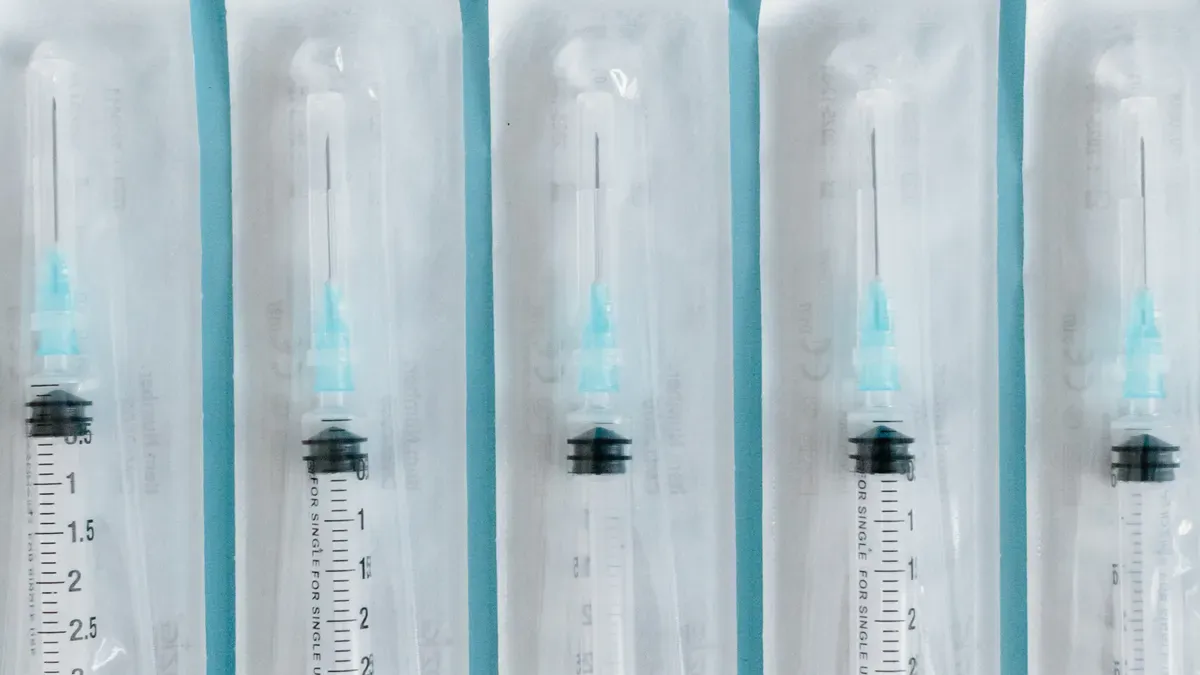
Always use clean, single-use cartridges, and push them in firmly to keep things safe and effective.
Meso Needle Basics: What Pin Count Changes
Needle Count and Coverage Per Pass
A single needle does one injection each time it goes in. That method is slow, and the space between sites changes from pass to pass. A multi-needle head changes the math. It does synchronized micro-injections with every insertion, so one press puts product across several points at once.
Multi-needle heads with 3, 5, 9, or 25 pins attach to mesotherapy guns or rollers. These setups work well for larger surface areas, like the neck, décolleté, or full face. Each pass covers more injection points, so you need fewer passes. Session time drops, and the spacing between sites becomes more even. Even spacing supports consistent intradermal injection dosing across the treated area. That consistency helps you avoid the patchy results that uneven distribution can cause.
Spacing, Speed, and Comfort Trade-Offs
A higher pin count means faster coverage. It does not automatically mean better results. A multi-needle for meso-therapy trades some precision for speed. The clustered needle array covers more skin per stamp, yet fine targeting becomes harder. Delicate zones, like the eye area, still call for a single needle or a low-pin head.
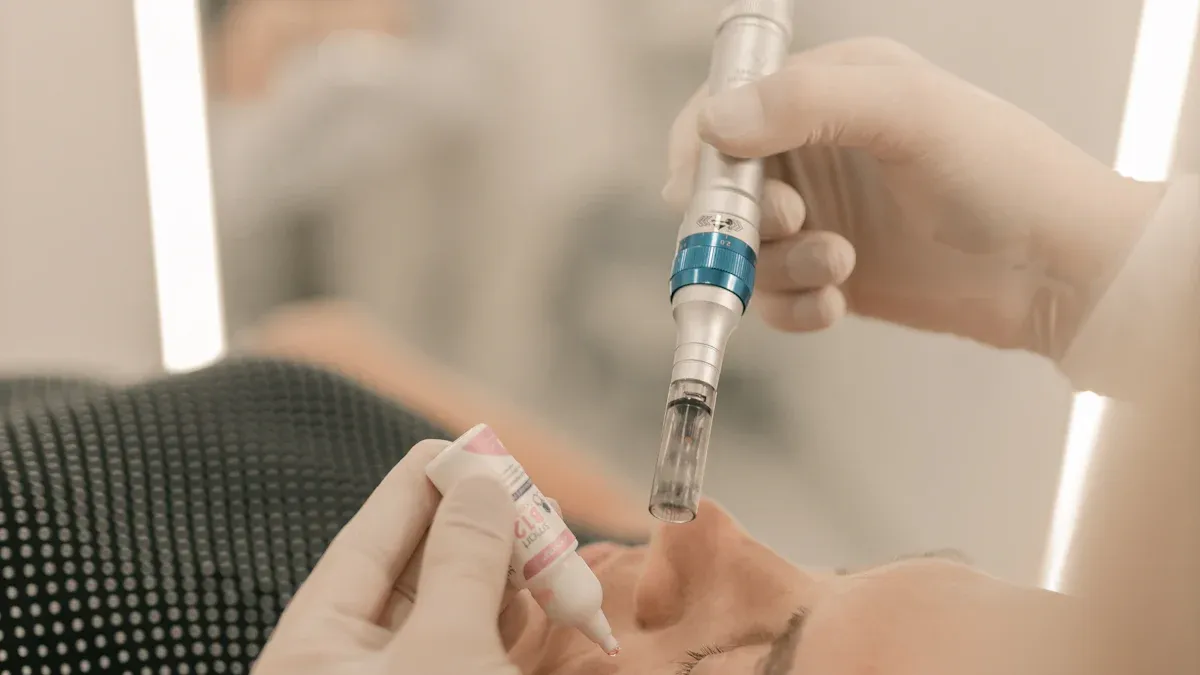
Comfort follows a similar logic. Multi-needle systems on a mesotherapy machine reduce pain and save time during high-repetition, large-area work. Finer gauges, like a 34G needle, further soften the sensation. Crystal options with an adsorption function add comfort during delivery. Standard multi-pin cartridges and other needle cartridges vary in how they feel, so gauge and tip design matter as much as pin count.
Good outcomes also depend on solid vertical needle penetration. A stable needle array supports vertical alignment and consistent needle penetration across the site. That penetration uniformity keeps depth predictable, and predictable needle depth protects results. Whether you run microneedling with a derma stamp, a roller, or a gun, match the cartridge to the zone. Check that each sterile injectable needle seats firmly before use. A well-seated cartridge protects penetration quality during every pass.
3-Pin Meso Needle: Comfort Comes First
Design and Needle Depth Control
The 3-pin head is the smallest choice in the multi-pin group. It works well for clients who feel pain easily and for small areas where a bigger head feels like too much. Fewer pins mean less skin contact with each press, so the feeling stays gentle.
A low pin count also gives you tighter control over needle depth and placement in small zones. You can guide the head more freely, and each pass lands where you want it. That control matters in meso-therapy work near delicate features. Pair the head with a sterile injectable needle cartridge that seats firmly, and you protect precise needle penetration on every pass.
Best Uses, Compliance, and Cost
Match needle length to the zone. The table below shows the recommended pairing.
Needle Length
Recommended Treatment Area
Rationale
0.6 mm
Under and around the eyes
Thin skin; only subcutaneous layer needed; short length for safety
0.8 mm
Neck (wrinkle removal)
Ensures liquid enters skin with less pain
1.0 mm
Face
Deeper skin tissue needed for face mesotherapy
1.2 mm
Face or body
Delivers medication deep into muscle tissue
1.5 mm
Scalp (e.g., hair loss)
Reaches appropriate depth on thin scalp layer safely
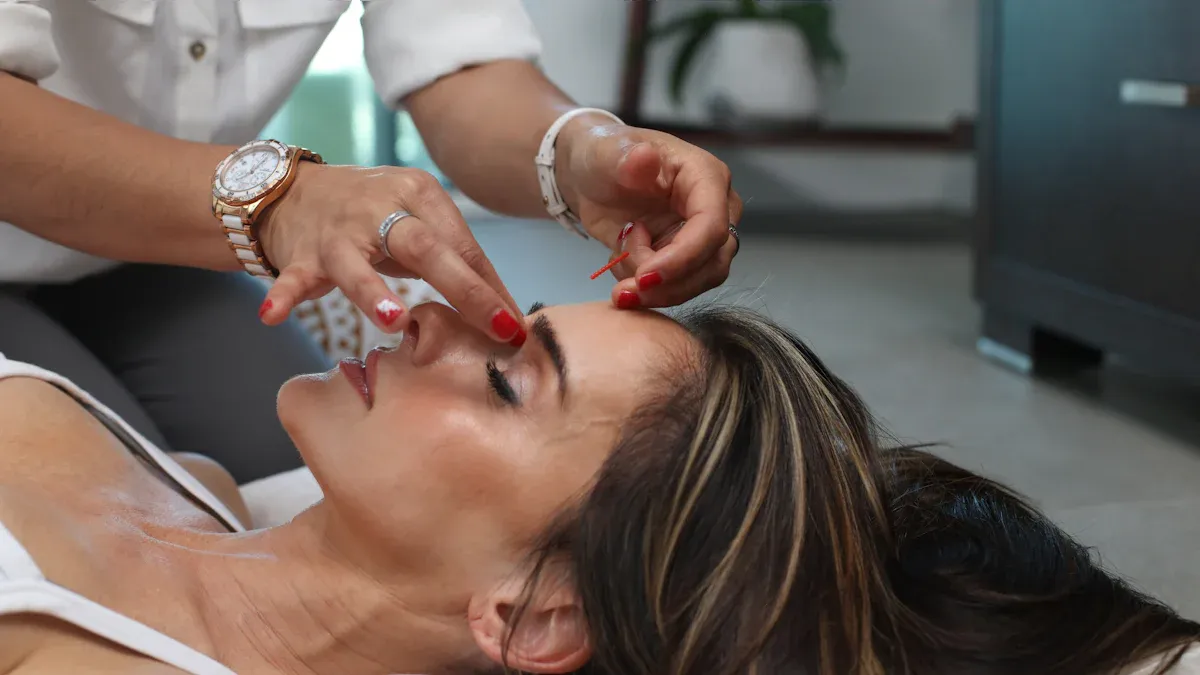
Practitioners also use the 3-pin around the eye area with skin boosters and essences to reduce dark circles and fine lines. Its short length makes periocular work especially safe. For larger zones, a multi-needle head with more pins covers ground faster, so keep a second type on hand.
For compliance, source sterile single-use needle cartridges with clear lot tracing and documented quality control. Single-use cartridges protect both client and clinic. Cost per treatment runs fairly low because each session uses little product, which makes the 3-pin a practical fit for small-area microneedling rather than a lesser choice.
4-Pin Multi-Needle for Meso-Therapy: Balanced Control
Design and Efficiency Gains
The 4-pin multi-needle was made for a practical reason. Practitioners wanted more convenience and efficiency in daily meso-therapy work. They also wanted device safety secured at the same time. Four needles on one hub give four synchronized points per press. That layout speeds up a session without pushing the head into high-throughput territory.
The head stays medical-grade fine, so precision does not drop away. You get a face and scalp setup that suits both zones. A 4-pin multi-needle for meso-therapy sits between the 3-pin and the 5-pin in coverage. It gives you more reach than three needles and more control than five. For microneedling on the face, that balance keeps your passes steady. For microneedling on the scalp, the extra points save time over a low-pin head.
Best Uses, Compliance, and Cost
Use the 4-pin for mid-sized zones where you want speed and control together. The forehead, cheeks, and hairline respond well to this setup. Load a sterile injectable needle cartridge that seats firmly, and check the fit before each pass. A well-seated needle cartridge protects needle penetration quality. It also keeps needle depth predictable across the whole treatment.
Compliance starts with sourcing. Buy single-use cartridges with clear lot tracing and documented quality control. Single-use cartridges protect both you and your client. Cost per treatment lands in the middle of the range. The 4-pin uses more product than a 3-pin head and less than a 9-pin head. That makes it a sensible middle ground between control and speed. Keep a few boxes of these needle cartridges beside your other cartridges, and you can switch setups without slowing the schedule. Many clinics pair this head with a 3-pin for fine zones and a 9-pin for broad areas. The four needles handle the everyday middle work, and microneedling sessions run smoothly from start to finish.
The 5-pin head creates a smaller, more focused pattern than a 9-pin head. It hits 5 points at one time, so you finish injections faster than you would with lower pin counts. That focus suits zones where you want multi-point delivery without spreading product too wide.
You can also choose the 5-pin in crystal multi-needle options for localized multi-point delivery. Crystal tips support smooth product flow during each pass. Pair the head with a sterile injectable needle cartridge that seats firmly, and you protect needle penetration quality on every stamp. A well-seated cartridge keeps needle depth predictable across the treated zone. That stability matters in meso-therapy, where even spacing supports consistent intradermal injection dosing.
Best Uses, Compliance, and Cost
Use the 5-pin for mid-sized zones that need more reach than a 4-pin head and tighter focus than a 9-pin head. The cheeks, jawline, and neck respond well to this setup. Load single-use cartridges with clear lot tracing, and check the fit before each pass. Single-use cartridges protect both you and your client.
Cost per treatment sits between the 4-pin and the 9-pin. The 5-pin uses more product than a 4-pin head and less than a 9-pin head. That makes it a practical middle option for clinics that run regular microneedling sessions. Keep a few boxes of these needle cartridges beside your other cartridges, and you can switch setups without slowing the schedule. Many clinics pair this head with a 3-pin for fine zones and a 9-pin for broad areas. The five needles handle the everyday middle work, and microneedling sessions run smoothly from start to finish. A second type on hand also helps when a client needs a different pattern mid-session.
9-Pin Multi-Needle: High-Throughput Coverage
Design and Injection Speed
A 9-pin multi-needle gives you 9 injection points with every press. That changes how you plan a session. Heads with fewer pins cannot keep up with that speed on a large area.
This head gives you wider manual-injection coverage than a 3-pin, 4-pin, or 5-pin setup. It is a precision-made medical consumable built for advanced aesthetic treatments such as mesotherapy and skin boosters. Each needle sits in a fixed array, so penetration stays vertical and depth stays predictable across the field. You still control the handpiece. The array simply multiplies each stroke.
Best Uses, Compliance, and Cost
Choose the 9-pin for large areas: the full face, neck, décolleté, and body zones. Load a sterile injectable needle cartridge that seats firmly, and confirm the fit before each pass. A well-seated cartridge protects needle depth and keeps dosing even.
Compliance and cost deserve a close look before you order.
Consideration
Detail
Device classification
Single-use medical device for accurate intradermal injection
Sterility
Each needle is sterile-packed
Material
High-grade stainless steel, corrosion-resistant and sharp
Unit price
$4.20, discounted from $5.00
Ask suppliers for an ISO 10993-1 evaluation report covering cytotoxicity, sensitization, and irritation tests. Set sampling to ISO 2859-1 with AQL 0.0 for critical defects and AQL 1.5 for major ones. Run an ISO 14971 risk audit, and reject lots with torn blister seals. Cost per treatment stays efficient because one pass covers so much ground. Keep a 3-pin nearby for fine zones, and your microneedling schedule runs fast without losing control.
Comparing Meso Needle Types: Which to Choose
Side-by-Side Comparison Table
The table below shows all four heads in one view. Use it as a quick reference before you order.
Feature
3-Pin
4-Pin
5-Pin
9-Pin
Points per press
3
4
5
9
Typical area
Eyes, fine lines
Forehead, cheeks, hairline
Cheeks, jawline, neck
Full face, neck, body
Injection speed
Slowest
Moderate
Moderate-fast
Fastest
Comfort level
Highest
High
High
Good on large zones
Depth control
Tightest
Tight
Balanced
Broad field, fixed array
Compliance notes
Single-use, lot-traced
Single-use, lot-traced
Single-use, lot-traced
Sterile-packed, ISO 10993-1 report available
Relative cost
Low product use
Middle
Middle
Efficient per pass
Depth settings on compatible mesotherapy guns adjust from 0.25 mm to 5 mm in 0.25 mm steps, with speed from 10 to 250 injections per minute. Those ranges apply across heads, so pin count shapes coverage while the device shapes delivery.
Matching Pin Count to Treatment Needs
Start with the treatment area. Small zones such as the eye area suit the 3-pin, where tight control over needle depth matters most. Mid-sized zones such as the forehead and jawline fit the 4-pin or 5-pin. Large zones such as the full face, neck, and body reward the 9-pin.
Next, weigh solution viscosity. Thinner formulas flow easily through fine gauges. Thicker formulas need a larger gauge to keep flow steady. Gauge affects flow rate and comfort, while needle length sets delivery depth. Ultra-fine 33G–34G needles suit delicate, superficial areas, and 30G–32G at 4 mm suits standard mesotherapy.
Comfort comes third. Facial work typically stays within 1–4 mm, and 30G–32G needles reduce pain and bruising there. Body zones such as the abdomen and thighs call for 8–13 mm at 27G–30G to reach deeper layers. Assess each patient's sensitivity before you pick a head, and let feedback guide adjustments.
Budget closes the loop. The 3-pin uses little product per session. The 9-pin spreads cost across more points per pass. Clinics that run mixed caseloads often keep several types on hand, and customizable needle configurations let you match the head to the case rather than the reverse.
One practical note on fit: seat every cartridge firmly before the first pass. A well-seated cartridge protects penetration quality and keeps depth predictable. Stock needle cartridges with clear lot tracing, and rotate stock so older cartridges move first.
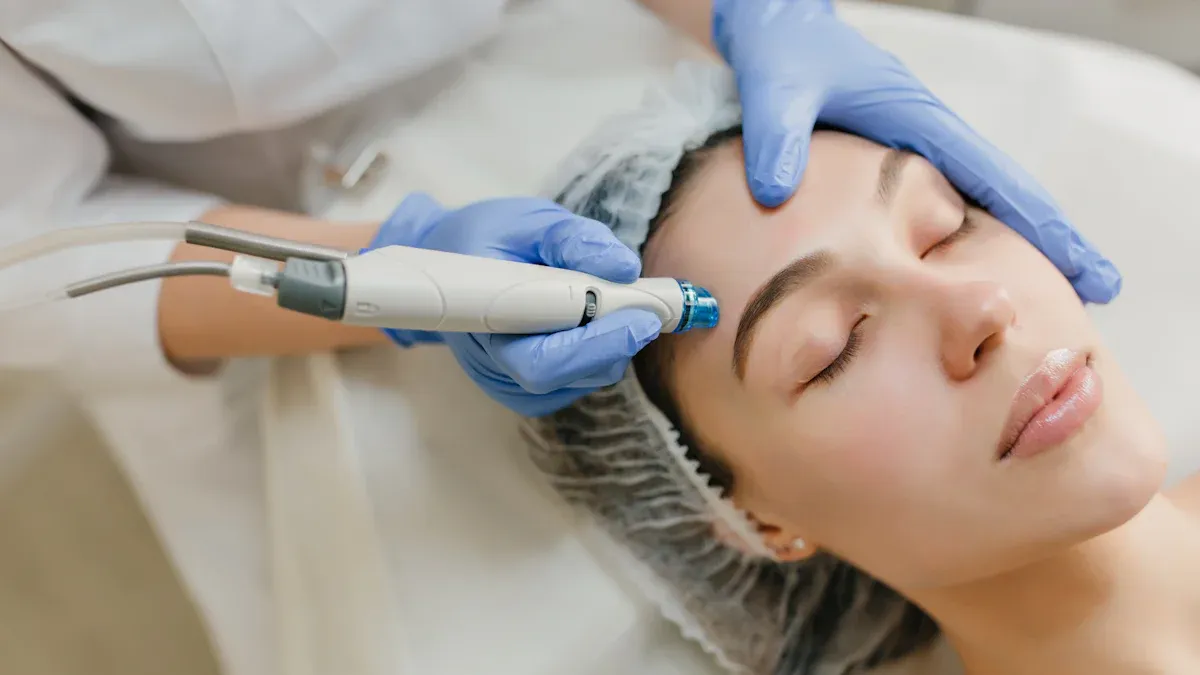
For context, Contriu's microneedling range includes derma stamps, derma rollers, and a no-needle mesotherapy gun. These tools complement multi-needle heads rather than replace them. A roller handles surface stimulation, a stamp supports shallow delivery, and a gun drives automated, high-speed delivery. Many clinics combine a gun with 3-pin and 9-pin heads for full coverage across microneedling sessions.
Pin count is a tool-selection decision. Treatment area size, solution viscosity, speed, comfort, and budget all shape your choice. Start from the treatment goal, then pick the configuration that fits it. Many clinics keep more than one type on hand, so you can match the head to each case.
For microneedling on small zones, reach for the 3-pin. For microneedling across broad areas, the 9-pin saves time. Mid-sized work suits the 4-pin or 5-pin. Seat every cartridge firmly, and check depth before each pass. Stock cartridges with clear lot tracing, and rotate stock.
Meso-therapy rewards planning. Weigh needle gauge against solution thickness, and confirm injection depth suits the zone. Keep spare needles ready, and log each cartridge lot.
Revisit the comparison table before your next order.
FAQ
Which pin count suits large areas like the back?
Reach for the 9-pin head. It places 9 points with every press. Keep a 3-pin nearby for fine zones. That pairing keeps your microneedling schedule fast, and you waste fewer cartridges on small areas. One needle type rarely covers a whole caseload.
Does a higher pin count hurt more?
Not automatically. Comfort depends on gauge and tip design as much as pin count. A 34G needle feels softer than a thicker one. Depth control matters most near the eyes, where you want a short setting. Match the cartridge to the zone, and check the injection depth before the first pass. Your microneedling clients will notice the difference.
Can you reuse needle cartridges between clients?
No. Treat every head as single-use. Reusing cartridges risks contamination and dulls the tip, which harms penetration quality. Seat a fresh cartridge firmly before each session, and log the lot number. Discard used cartridges right away. Single-use practice protects both you and your client.
How do you choose needle length and gauge?
Facial work stays within 1–4 mm at 30G–32G. Body zones such as the abdomen need 8–13 mm at 27G–30G. Thin formulas flow through fine gauges, and thick ones need a larger gauge. Confirm depth before each pass. Stock cartridges in several lengths, and your microneedling sessions stay flexible.
Can you switch heads mid-session?
Yes. Many clinics pair a 3-pin with a 9-pin. Start with the 9-pin across broad zones, then switch to the 3-pin around the eyes. A second head on hand keeps microneedling sessions moving. Plan the order before you begin, and you avoid delays mid-treatment.