Two-component adhesives and sealants are widely used in automotive assembly, electronics, construction, composites, and industrial manufacturing. As these materials become more specialized, manufacturers are facing a practical challenge: how to mix two components evenly while maintaining stable dispensing.
For many 2K adhesive systems, the mixing tube is one of the final steps before the material reaches the application surface. Even when the two components are accurately dosed, poor mixing can result in uneven curing, weak bonding, inconsistent sealing, or visible differences in the finished material.
This becomes more difficult when the adhesive has high or unusual viscosity.
Why High-Viscosity Adhesives Are Difficult to Mix
Viscosity has a direct influence on how easily adhesive components move through a mixer. Epoxy, polyurethane, silicone, structural adhesives, and other two-component materials can have very different flow characteristics.
The two components may also have different viscosities even when they are supplied at the correct mixing ratio. Temperature, pressure, flow rate, and shear can further change how the material behaves during dispensing.
Because of this, choosing a mixing tube based only on the adhesive's stated viscosity is not always enough. The complete dispensing process needs to be considered.
For production applications, manufacturers normally need to balance several factors, including:
● Mixing uniformity
● Adhesive viscosity
● Mixing ratio
● Required flow rate
● Pressure during dispensing
● Working temperature
● Adhesive pot life
● Connection and sealing stability
A mixer that performs well in a small laboratory test may behave differently during continuous industrial dispensing.
Static and Dynamic Mixing Approaches
Traditional static mixers use fixed internal elements to divide, redirect, and combine two materials as they pass through the tube. They are widely used because of their simple structure and reliable operating principle.
However, some high-viscosity or special-viscosity materials can present greater mixing challenges.
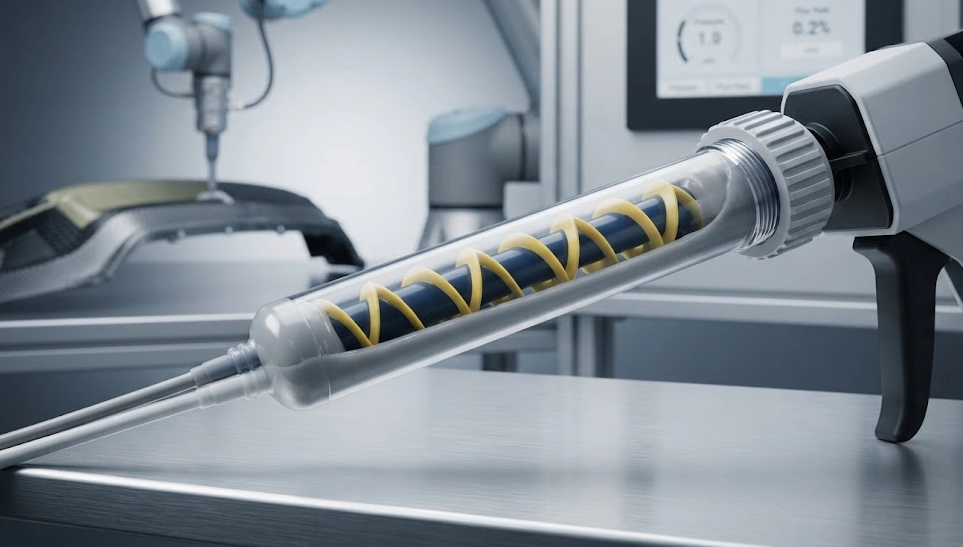
This is where dynamic mixing technology provides another option. The RM or RS Static Mixer series from Contriu is designed with sequential spiral blades that can rotate rapidly during the mixing process.
When two adhesive components enter the mixing tube, the spiral blades repeatedly divide and mix the materials. This increases interaction between the two fluids and helps produce a more uniform mixture before the adhesive reaches the outlet.
Although the product is often searched for using the keyword RM or RS Static Mixer, its rotating blade structure distinguishes it from conventional motionless static mixers.

Applications in the Adhesive Industry
The need for reliable two-component mixing can be found across many industrial applications.
In automotive manufacturing, 2K adhesives are used for bonding and sealing components. In electronics, adhesives and resins may be used for protection, bonding, and assembly. Construction and composite applications can also require materials that combine high strength with controlled dispensing.
For these applications, the mixer needs to match the material rather than simply fit the dispensing equipment.
The Contriu RM/RS series is intended for liquid materials with special viscosity characteristics. Its spiral-blade structure provides a practical option for applications where conventional static mixing may not provide the desired mixing performance.
Different RM and RS configurations are available for different dispensing requirements, so selection should be based on factors such as material properties, flow rate, equipment connection, and application conditions.
Pressure Is Just as Important as Mixing Quality
One common mistake is to focus only on whether the adhesive looks well mixed at the outlet.
A mixing tube also needs to maintain an acceptable pressure level. If a highly viscous adhesive is forced through a mixer that is too small or too restrictive, pressure can increase significantly. This may affect dispensing stability and place additional demands on the dispensing equipment.
Therefore, mixer diameter, internal geometry, adhesive viscosity, and flow rate should be evaluated together.
For automated production lines, this becomes even more important. A suitable mixing tube should provide consistent performance throughout the required operating range instead of only working under one set of test conditions.
Sealing and Connection Stability
The connection between the mixing tube and dispensing system is another important practical detail.
Poor sealing can cause leakage, material waste, contamination, and production interruptions. A stable connection is especially important in applications where mixing tubes are frequently replaced.
The Contriu RM/RS series uses a specially designed screw-tooth structure at the adhesive outlet to support sealing and connection stability. This design detail can help make the dispensing process more reliable during repeated industrial use.
How to Select the Right Mixing Tube
There is no single mixing tube that is suitable for every adhesive.
Before selecting an RM Static Mixer, RS Static Mixer, or another mixing solution, manufacturers should first understand the actual application. The adhesive type, component ratio, viscosity, temperature, flow rate, dispensing pressure, and required mixing quality should all be considered.
For difficult or high-viscosity materials, testing under actual working conditions is particularly useful. It allows manufacturers to check not only the final mixing quality but also pressure, dispensing speed, material waste, and connection stability.
The goal is not simply to use more mixing elements. The better approach is to find a mixer geometry that provides sufficient mixing while keeping the entire dispensing process stable and practical.
A More Practical Approach to 2K Adhesive Mixing
As two-component adhesives continue to expand into automated manufacturing, mixing technology is becoming an increasingly important part of the dispensing process.
For standard materials, conventional static mixing may be sufficient. For special-viscosity materials, however, a dynamic solution can provide another way to improve mixing interaction.
The Contriu RM/RS dynamic mixing tube combines rapidly rotating spiral blades with a practical outlet connection design, making it suitable for selected high-viscosity and special-viscosity adhesive applications.
For buyers and engineers, the key is to look beyond the mixer itself. Matching the adhesive, dispensing system, mixing structure, flow rate, and operating conditions is what ultimately determines whether a two-component dispensing process can remain stable and consistent.