Home > News > Blog > What should clinics compare before choosing a hair transplant pen supplier?
share
What should clinics compare before choosing a hair transplant pen supplier?
Sep 25Source:Intelligent Browse: 76
Clinics have a big choice to make. Picking a hair transplant pen supplier affects your results. It also affects patient safety and how well your practice runs. Your clinic needs to check product quality and safety. Make sure it works with the tools you already have. Look at the supplier's reputation, cost, and rules they follow. Check their customer support and training. Clinics depend on this tool for graft implantation. Comparing these clinic quality factors helps your clinic avoid costly mistakes. It matches the supplier with what you need. Each clinic should focus on precision for every graft. A careful review protects your clinic.
Be sure the pen fits your tools and graft sizes so you can implant precisely.
Check the supplier's reputation by looking at their clinical references and inventory stability.
Look at the full cost over time, not just the price per piece, to get the true value.
Choose a supplier that provides training, help, and the right medical certifications.
Product Quality And Safety
Materials And Construction
Start your supplier check by looking at the materials inside the pen. The metal parts must not rust and must stay sharp through many uses. A good pen uses surgical stainless steel for the tip and strong plastic for the body. This makes the tool light and easy to hold. The steel does not rust from water or cleaning fluids. A sharp tip matters for every graft you place. Dull edges hurt the tissue more and make the procedure slower.
The table below shows how key material properties affect performance and longevity.
Material Property
Effect on Performance
Effect on Longevity
Sharpness
Enables razor-sharp edges, reduces cutting forces, less heat generation
Maintains precise cuts over time
Toughness
Withstands high-stress cutting, resists chipping and cracking
Prevents premature blade failure
Edge retention
Maintains sharp edge over extended use
Reduces need for frequent resharpening
Rust resistance
Immune to moisture, acids, and corrosive agents
Performance remains uncompromised in humid environments
Sharpening requirements
Specialized diamond or laser-based sharpening needed
Longevity benefits compensate for intricate resharpening
Contriu's Hair Transplant Pen is a good example. The maker builds this tool with surgical stainless steel and offers sizes from 0.6mm to 1.2mm. That range fits different graft sizes and hair types. Your clinic gets flexibility for different cases.
Sterility And Single-Use Options
Sterility keeps your patients safe and protects your reputation. You must check that every pen or cartridge comes clean and ready to use. Single-use items lower the risk of cross-contamination between cases. Tools you can reuse need proven cleaning cycles. Ask your supplier for safety certification proof before you decide. The table below lists relevant standards.
Standard
Scope / Relevance
ISO 7153-1
Specifies surgical stainless steel for reusable implant drivers
ISO 13485
Quality management system for medical device manufacturing
ISO 9001
General manufacturing standards for instrument production
EN ISO 11607-1
Validates packaging sterility for hair implanters
ASTM F138
Material certification for surgical steel in quality assurance
These standards give your clinic a way to judge any supplier. A pen that meets ISO 13485 and ASTM F138 shows real care for quality. You should also check the graft storage steps and solution your team uses. These steps affect graft survival. Your safety steps should cover implantation angle and depth for every case. Steady graft placement depends on these details. A reliable implanter pen supports that steadiness.
Every clinic wants precision. Precision in implantation comes from tools you can trust. Contriu backs its pen with after-sales support and a quality promise. You should confirm these points before making a final choice. Ask for samples and test the pen in your own setting. This step shows how the tool works under real conditions. Your clinic deserves a supplier who meets these standards every time.
Compatibility With Existing Clinical Tools
Pen Design And Handpiece Integration
Your clinic needs to see how a new hair transplant pen works with your current tools. A good pen should feel steady in your hand during long procedures. The weight and grip change how you control each graft placement. You should test how the pen fits with handpieces you already use for FUE and Choi pen methods. Some pens work better with certain handpiece models. Ask your supplier about compatibility before you buy.
A comfortable fit matters when surgeons place grafts by hand. A pen that tires your hand can lower your precision over time. Your clinic should check the pen's length, diameter, and balance point. These things affect your implantation angle and graft survival. Ask for a sample and practice with it in your normal workflow. This step shows if the pen fits smoothly or causes problems.
Cartridge And Needle Compatibility
Cartridge and needle choices decide how flexible you are during procedures. You need sizes that match different graft counts and hair types. A pen with adjustable settings lets you switch between cases without changing tools. Check if the cartridge system locks tightly and releases easily. Loose connections can harm grafts during implantation.
The table below shows how size ranges meet different clinical needs.
Size Range
Typical Use
0.6mm to 0.8mm
Smaller grafts, fine hair
0.9mm to 1.0mm
Standard grafts, most procedures
1.1mm to 1.2mm
Larger grafts, thicker hair
Suppliers that offer OEM/ODM services, like Contriu, let your clinic customize the implantation tool. You can ask for specific sizes or branding that match your practice needs. This choice helps your clinic keep things consistent across your equipment. A supplier who supports customization shows commitment to your long-term success. Your clinic gets an implanter pen that fits your technique selection and patient population.
Supplier Reputation And Reliability
When you check a hair transplant pen, you must also look closely at the supplier's reputation and reliability. A supplier with a strong track record gives you confidence in every graft you place. You should ask for written quotes from at least three suppliers. Score each one using the same checkpoints. These checkpoints include surgeon experience, license, accreditation, portfolio, graft count, and aftercare support. This structured approach lets you compare options fairly. A supplier who cannot provide clear references should raise a red flag. You need proof of consistent performance. Your clinic depends on this information to make a smart choice.
Track Record And Clinical References
Verifying a supplier's track record starts with clinical references. Ask for contact information of clinics that use their hair transplant pen regularly. Speak directly with those clinics about their experience. Ask about graft survival rates and ease of implantation. Ask how the pen performs over many procedures. A reputable supplier shares a comprehensive before-and-after photo gallery of patients. Review these photos to assess the results. Look for consistent graft placement and natural-looking outcomes. The portfolio should show a range of graft counts and hair types. This diversity proves the pen works across different patient populations. You should also check the supplier's accreditation and licenses. Medical standards demand that suppliers meet ISO 13485 or equivalent certification. This certification confirms their commitment to patient safety. Your clinic needs a supplier who follows these standards. A supplier who offers training on graft handling shows dedication to your success. This support helps your team achieve precision with each graft they place. You need a partner who supports every aspect of your work.
Inventory Consistency And Lead Times
Supply chain stability affects your clinic's daily operations. You must verify inventory consistency before signing a contract. Ask about average lead times for standard orders. A supplier with a reliable inventory system ships your order within days, not weeks. Disruptions can halt procedures and delay patient care. You need a supplier who maintains adequate stock year-round. Check if they have contingency plans for high-demand periods. Some suppliers produce limited batches, which creates risk for your clinic. You should also confirm their shipping methods and customs handling. International shipments face delays that affect your graft supply. A supplier with fast shipping options reduces this risk. Your clinic depends on timely delivery for every scheduled procedure. Run a test order before committing to a large contract. This test reveals the real lead time and packaging quality. Evaluate how they handle each graft and cartridge component. Proper packaging protects every graft during transit. You deserve a partner who values reliability as much as you do. A consistent supply supports your clinic's reputation.
Cost And Value Considerations
Unit Pricing And Bulk Discounts
Price is important, but the cheapest hair transplant pen is not always the best for your clinic. You should think about experience, safety, and long-term results before you go after a low price. A supplier who uses poor materials may cost your clinic more because of bad graft survival and repeat orders. Ask each supplier for their unit pricing and bulk discount plan. Many suppliers lower the cost per unit when you order in larger amounts. Compare those price tiers across at least three sellers. A lower unit price at high volume only helps if the pen meets your quality standards.
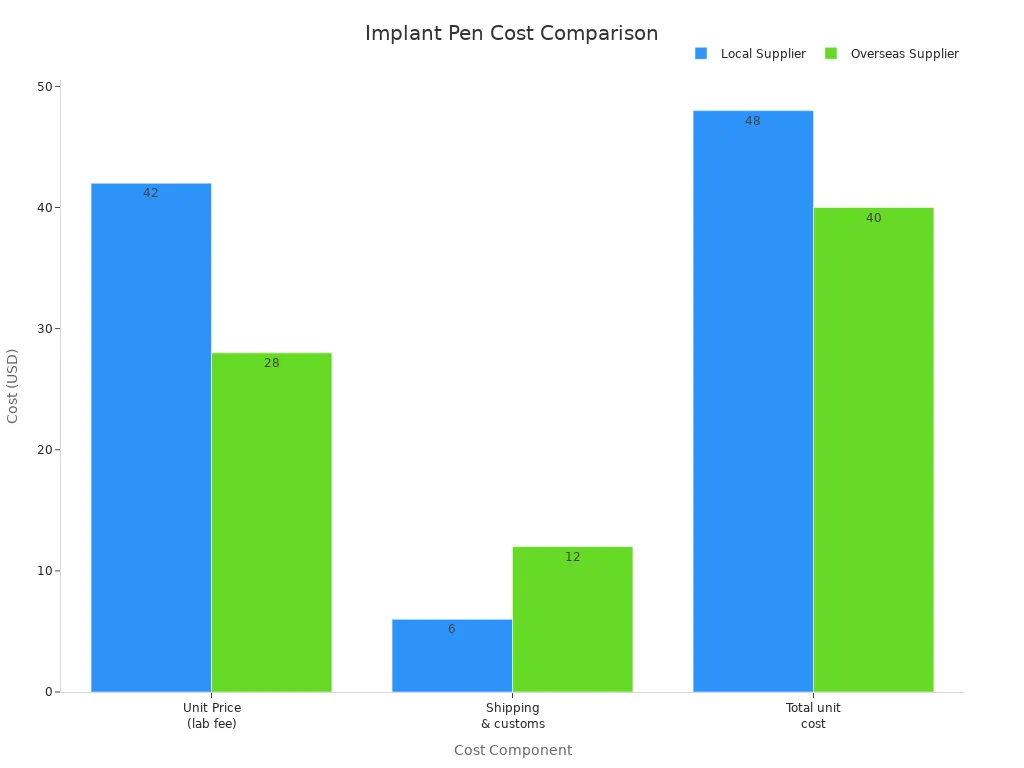
Local and overseas suppliers price their products in different ways. The table below shows one comparison.
Cost Component
Local Supplier
Overseas Supplier (e.g., China)
Unit price (lab fee)
$42
$28
Shipping & customs
$6 (shipping only)
$12 (shipping + customs)
Total unit cost (fee + shipping/customs)
$48
$40
Remake rate
3%
2%
Chairside time
16 min
15 min
Total cost of ownership (TCO)
$129.44
$115.80
The overseas supplier's total unit cost ($40) is lower than the local supplier's ($48) once you add shipping and customs. Overseas unit prices often run half to one-third of local prices, even though shipping and customs costs are higher and change more often.
Total Cost Of Ownership
Total cost of ownership is more than just the purchase price. You must include durability, sterility, and how often you replace the pen. Single-use and reusable pens have different cost profiles. The table below breaks down those differences.
Cost Factor
Single-Use (Disposable) Pens
Reusable Pens
Initial cost
Lower per-unit cost; no sterilization or maintenance investment required
Higher upfront investment
Ongoing expenses
Continuous repurchasing creates consistent out-of-pocket costs that can accumulate over time
Cost per procedure decreases with repeated use if properly maintained
Sterilization and maintenance
No additional sterilization or maintenance expenses
Requires specific cleaning solutions and sterilization practices, adding extra costs
Long-term cost outcome
May become more expensive over time for high-volume artists due to repeated purchases
May be more cost-effective in the long run for busy professionals performing many procedures
Business impact
Recurring costs can affect profitability and pricing strategies
Durability and reliability may justify the initial outlay and support service quality over many applications
Your clinic should compare local and overseas suppliers on more than price. Shipping costs, customs, and after-sales support all affect your bottom line. A supplier who offers training and quick support adds value that a cheap unit price cannot match. Your clinic needs a partner who supports precision in every implantation. Choose a supplier who helps your clinic grow.
Customer Support, Training, And Regulatory Compliance
Training Resources And Technical Support
A good supplier gives your clinic more than just a product. They offer training to help your team learn every step. You need hands-on help with scalp checks, donor area checks, and hair loss pattern review using magnification. This special training builds confidence before you do implantation on real patients.
Even automated pens need skilled handling to get the best results. Contriu gives training help to clinics that use their devices.
Your clinic should ask about choi pen training and hair transplant training choices. A good supplier gives video tutorials, written guides, and in-person sessions. These cover graft handling, graft storage steps, and equipment setup. Your team needs quick access to technical support during procedures. Fast answers cut downtime and keep patient results safe.
Certifications And Quality Assurance
You must check that any implantation tool meets medical standards. Ask your supplier for proof of certification before you commit. A trusted supplier holds these credentials:
ISO 13485 certification for its quality system, checked by an outside auditor
CE marking under EU Medical Device Rules (MDR) on tools that need it
Papers you can get with each order: Certificates of Analysis (COA), lot tracking records, and sterilization proof reports
These papers show the supplier follows strict quality steps. Your clinic should look at ISO 14971 for risk management and IEC 62304 for software life cycle rules. These rules apply to making medical tools. A supplier that meets these rules shows real care for safety.
Contriu gives after-sales help and a promise of quality. You should check these points before you decide. Ask for samples and try the pen in your own clinic. This step shows how the tool works in real conditions. Your clinic deserves a supplier that supports precision in every graft placement. A careful review keeps your patients and your practice safe.
You now know what to compare. Check product quality and safety first. Make sure the pen works with your tools. Look at supplier reliability, cost, and value. Review support, training, and rules. A fair review helps your clinic balance patient needs, budget, and a lasting partnership. Ask for samples. Ask for clinical references. Test each graft placement yourself. Your clinic should score every supplier on the same points. Your clinic needs proof, not promises. The right implantation tool protects every graft. Strong support helps your clinic place each graft with care. Good training raises graft survival. A trusted partner improves patient outcomes. Your clinic grows when every graft counts.
FAQ
What sizes does a hair transplant pen come in?
A hair transplant pen comes in sizes from 0.6mm to 1.2mm. Your clinic picks the right size for each graft. Small sizes match fine hair. Large sizes fit thick hair. Your clinic needs the right size for good results.
Should you choose single-use or reusable pens?
Single-use pens stop contamination between patients. Reusable pens cut your clinic's costs over time. Your clinic checks its volume and budget before choosing. A supplier must prove sterility for both types.
What qualifications should your clinic check in a supplier?
Your clinic needs proof of ISO 13485 certification. Your clinic looks at clinical references and patient photos. Your clinic asks for written quotes from at least three suppliers.
Can your clinic customize the pen design?
Yes. A supplier like Contriu offers OEM/ODM services. Your clinic asks for specific sizes or branding. Customization makes sure the tool helps your technique. This flexibility fits every graft you place.
What after-sales support should your clinic expect?
Your clinic needs training materials and technical help. Your clinic gets video guides and hands-on sessions. Your clinic gains from quick aid during procedures. A good supplier supports every graft with fast service.